
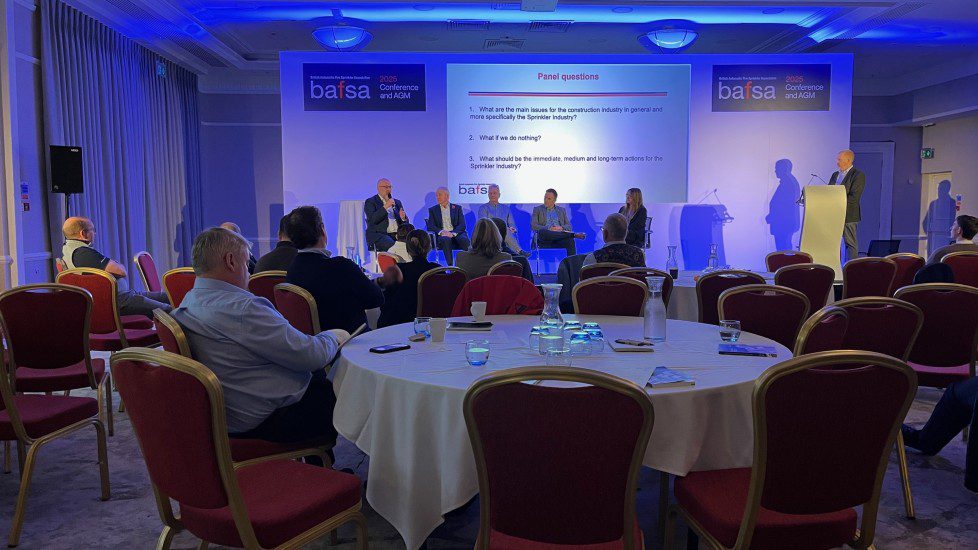
This year’s annual BAFSA conference and learning sessions (followed by the usual very busy formal dinner) were held in early November at the Marriott Forest of Arden Hotel in Coventry. Thank you to BAFSA for an engaging programme.
This year’s focus was on the built environment, sustainability, and how fire sprinklers can help with the challenges faced.
Firstly, Mike Leonard (CEO of the Building Alliance) discussed key outputs from the Grenfell report, and the systemic failures in UK building design, construction and management which almost certainly led to this disaster – as Mike has said before, sometimes the UK (and others, to be fair) seem to ‘manage by disaster’.
Secondly, and to us this piece struck quite hard, Terry McDermott (Secretary of the National Fire Sprinkler Network) interviewed Lorna Blanchenot (headteacher of Ravensdale Primary School) about the devastating 2020 fire which completely destroyed the school. More here.
What struck us most about the school fire is the level and length of disruption. Many would think: fire –> insurance claim -> rebuild -> move back in. But what most people wouldn’t think about is: having to find other places for potentially hundreds of children, some with special needs which adds to the difficulty; teachers having to travel to different sites across a city; siblings and friends having to be split up for long periods of time; families having to get their children to a different site, sometimes several; ongoing and endless debates with the insurers about ‘do you really need that?’; re-recruiting the many teachers who could not cope and ended up taking new jobs elsewhere…in fact, the list goes on…! Needless to say, when the school was eventually rebuilt and refitted, sprinklers were part of the design.
Thirdly, Jim Glockling (FPA’s Technical Director) and Dale Kinnersley (FPA Principal Consultant) spoke about adapting to net zero (video here), which involves the adoption in building of many renewable materials which in fact have a heavy fire load, the main one being timber. One of the key issues of course is how quickly timber can fail, obviously in the case of fire, but also in the case of hidden damp and rot; and also how sprinkler fixings into the timber can also fail much more quickly than perhaps anticipated.
Jim also included an interesting section covering how more building design decisions are being based on carbon footprint, and the growing importance of environmental declarations – this is something that SEP is already working on, so if this is important to any of your up-coming projects then please contact us as early as possible because as you may imagine, trying to collect all the necessary information can be very involved.
If any of these topics are of interest, and we can offer any assistance with your needs, please Contact Us .